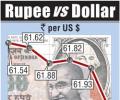
Forex dealers said weakness in local equities cast a shadow on the rupee. Dollar losing in overseas markets didn't impact the fall of the local currency, they added.

After another day of volatile trade, the rupee today appreciated by seven paise to close at a new one-month high of 59.04 against the dollar as the RBI's liquidity-tightening measures continued to lend support.

The NSE Nifty too ended 58.60 points, or 0.54 per cent, higher at 10,967.30 after shuttling between 10,985.15 and 10,928 during the session.

Bucking a strong trend in share market, the Indian rupee on Monday gave up all its initial gains and slipped 18 paise to close at 61.94 against the Greenback on rising dollar demand from importers.

In worldwide trade, the US dollar continued its highly bullish trend against all major emerging market currencies

Since March 31, 2022, the PSBs' market cap has risen 43.7 per cent, from Rs. 7.29 trillion to Rs. 10.47 trillion. It's time for the government, the majority owner of public sector banks, to reap the benefit of the rally in bank stocks, recommends Tamal Bandyopadhyay.

Continuing its rising streak for the third day, gold prices advanced by Rs 130 to Rs 27,470 per ten grams in the national capital on Wednesday on increased buying by jewellers and retailers amid ongoing festive season even as the metal weakened overseas.

The rupee has dropped by 83 paise or 1.24 per cent in three days

In dull trade, the rupee on Monday ended a mere two paise lower at 60.20 against the US dollar on weak local equities and imported-driven demand for the American currency.

The Indian currency had appreciated by a whopping 85 paise in three-day surge

An Indian Institute of Technology survey says every IIT-ian has created 100 jobs and that every rupee spent on an IIT-ian has 'created an economic impact of Rs 50 at the global level, half of which is India's share'.

The rupee strengthened by 13 paise to 61.67 against the US dollar at close.

A massive outflows of foreign funds on the back of stricter participatory notes and renewed possibility of Fed lifting US interest rates largely impacted the domestic unit.

'We will buy coolers if the need arises. It's very hot out there. We had brought Rs two lakh cash with us but have already spent about 5-6 lakh rupees so far.'

Consistent capital inflows and a recovery in local equities helped the local unit to trim initial losses

Frantic dollar demand from corporates along with an aggressive hedging strategy adopted by importers in the wake of the currency volatility predominately took a toll on the domestic unit despite moves by the central bank to stabilise the currency.

Heavy selling of the US dollar by banks and exporters in the face of renewed capital inflows predominantly kept sentiment highly buoyant

In forward market today, premium for dollar declined on sustained receivings from exporters.

'Many countries believe that if they join BRICS, they will be seen as emerging countries and their stature will be enhanced.' 'G-20 still has common action plans while BRICS does not do that much.'
The rupee largely shrugged off the high volatility in stocks and rebounded sharply towards the fag-end trade following bout of dollar selling by exporters

The government on Friday came out with Foreign Trade Policy (FTP) 2023 which seeks to boost the country's exports to $2 trillion by 2030 by shifting from incentives to remission and entitlement based regime. Unlike the practice of announcing 5-year FTP, the latest policy has no end date and will be updated as and when needed, said Director General of Foreign Trade (DGFT) Santosh Sarangi while briefing media about FTP 2023. Earlier, Commerce and Industry Minister Piyush Goyal unveiled FTP 2023 which will come into effect from April 1, 2023.
Rupee is under pressure against the dollar say currency watchers.
.jpg)
The rupee tumbled past 63.00 to the dollar, down about 2 per cent on the day and breaching the previous low of 62.03 hit on Friday despite a spate of measures in recent weeks by the central bank and government to defend it.

The rupee ended the day stronger against the dollar.

Lacklustre domestic equities alongside ongoing FCNR redemptions added pressure on the local currency

Mannapuram Finance, Mahindra and Bharti Axa are some of the firms known to have bought office spaces worth more than Rs 100 crore

The rupee continued its downslide for the second session in a row, depreciating by 20 paise to close at more than one-week low of 62.51 against the greenback.

Reflecting nervousness over the prospect of the Federal Reserve tightening policy and event risk, traders stayed on the sidelines
We asked you, our readers, to tell us about your first salary and how you spent it. Here's the latest set of responses we received.

Extending losses for the second straight day, the rupee declined by 11 paise to close at more than 3-week low of 66.93 against the US dollar.

It claimed doctors were being paid 'for referring medical tests'.
The rupee on Monday plunged to a two-week low of 66.61 by falling 47 paise against the US dollar on heavy demand for the American currency from importers.

The rupee extended gains for the fourth straight day against the US currency on Thursday.

The rupee resumed lower at 63.65 per dollar as against previous closing of 63.58 at the Interbank Foreign Exchange (Forex) market.

The rupee had strengthened by 19 paise on Monday.

India's foreign exchange reserves declined by a whopping $4.343 billion to $367.646 billion.

The Indian rupee was off to a bad start in the new year as it suffered the worst single-day drop in over two weeks today by falling 32 paise to end at 63.35 against the US dollar.
The American currency regained its buoyant strength after a brief sideways movement following overnight US Fed's optimistic tone about the future of the US economy

'Even where we are now today, the growth rates are very good, but we need to get to 8-9 per cent growth in the years to come.'

The report said the import cover has gone down to seven months, last seen in 1998 and hence, RBI will focus on recouping the reserves.
